The Death of the Menu: Why the Future of UX is Invisible

For decades, the “Digital Enterprise” has been a bit of a misnomer. We moved from paper to the cloud, but the underlying philosophy remained static. Our ERPs and CRMs have essentially been high-tech filing cabinets-passive repositories waiting for a human to enter data, click a button, or run a report.
With the advent of GenAI, we are witnessing the first true architectural shift since the cloud. We are moving from systems that store data to systems that understand it.
The Death of the “Standard” Interface
The most visible change isn’t a chatbot in the corner of your screen; it’s the total dissolution of the static user interface. We see this evolution happening across four distinct dimensions:
- From “Command” to “Intent”: Traditional UX is command-based-you must know which menu hides the report you need. The new paradigm is Intent-Based. You express a goal (“Show me why Q3 logistics costs spiked”), and the system assembles a custom UI on the fly, pulling together maps, charts, and tables that exist only for that moment.
- Anticipatory Design (Zero-UI): The most sophisticated interface is the one you don’t have to use. We are moving toward systems that act on implicit cues. Instead of waiting for you to log in, the system detects a supply chain anomaly and pushes a “micro-app” to your device with a pre-calculated solution ready for approval.
- Micro-Personalization at Scale: We are moving past “Hello [Name].” Future systems will adapt to your cognitive style. A visual thinker will see graphs; a detail-oriented auditor will see expanded data tables and outlier highlights. The software finally “morphes” to fit the user, rather than forcing the user to learn the software.
- Multimodal & Ambient Interfaces: The interface is leaving the desktop. Whether it’s an AR overlay on a factory floor or a voice-driven summary while you’re commuting, GenAI allows the enterprise “brain” to meet you wherever you are, in whatever format is most natural.
Enterprise UX Evolution
| Dimension | Traditional “Standard” Interface | AI-Native / Invisible Interface |
|---|---|---|
| Interaction Model | Command-based (Click menus, select reports) |
Intent-based (State goals, system assembles UI) |
| User Effort | User must search, navigate, and request | System anticipates and acts automatically |
| Interface Presence | Always visible dashboards & screens | Zero-UI: appears only when needed |
| Personalization | Static, same UI for all users | Micro-personalized to cognitive style |
| Decision Flow | Data → Human analysis → Action | Context → AI insight → Human approval |
| Timing | Reactive (after user input) | Proactive (before user asks) |
| Form Factor | Desktop & fixed screens | Multimodal: voice, mobile, AR, ambient |
| UI Lifespan | Persistent dashboards | Momentary, task-specific micro-UIs |
| Learning Curve | Users learn the software | Software adapts to the user |
The “Wall” We Haven’t Scaled (Yet)
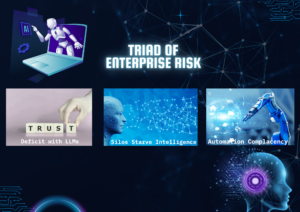
Despite this momentum, the transition isn’t a guaranteed “plug-and-play” success. To reach this future, we have to scale three significant walls:
- The Truth Problem: LLMs are probabilistic, but enterprise ledgers must be deterministic. You cannot have “hallucinations” in an accounting audit or a safety protocol. Bridging the gap between creative AI and rigid data accuracy is the current frontline of engineering.
- Context Fragmentation: AI is only as good as the data it can see. Currently, intelligence is siloed-your IDE knows your code, but it doesn’t know your project budget. The next leap requires Cross-Functional Intelligence that can see across the entire organizational stack.
- The Erosion of Agency: As systems become more “agentic,” there is a risk of humans becoming passive observers. If we stop questioning the AI’s logic because it’s 20x faster than us, we risk propagating errors at machine speed.
The New Human Role: Architect, Not Data Entry
As systems move from record-keeping to decision-support, our value as humans is shifting. We are moving away from the “drudgery of the click”- entering data and moving files.
Our role is becoming one of curation, validation, and intent. We are no longer the ones drawing the lines; we are the ones directing the pen. The enterprise systems of tomorrow won’t just be places where we “do work.” They will be the cognitive engines that help us think bigger, faster, and more clearly.
At Arina, we aren’t just watching this shift; we’re building the bridge to it. The digital enterprise is finally waking up. Is your business ready to stop “searching” and start “asking”?
The Executive Edge in Enterprise AI
Get the strategic intelligence that matters. Our monthly newsletter delivers actionable insights on AI ownership, data privacy, and competitive advantages curated specifically for C-level decision makers who refuse to compromise on control.
Sign up for NewsletterStart Your Journey with ArinaAI
Embark on a transformation journey into the future of innovation as you kickstart your exploration of ArinaAI, where limitless possibilities await at every click and command.