The EdTech Great Reset: Democratizing Expertise through Arina AI
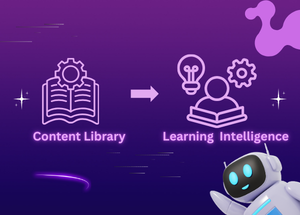
The “Netflix of Learning” model is dead. For a decade, the educational technology (EdTech) sector operated on a volume-based business model: accumulate vast libraries of video content, drive massive user acquisition, and monetize through recurring subscriptions. However, as generative AI commoditizes content production and personalizes the “last mile” of instruction, the industry is undergoing a structural “Great Reset”.
For C-suite leaders, this shift necessitates a fundamental rewiring of the enterprise learning and development (L&D) strategy. The value proposition has migrated from the Content Layer to the Intelligence Layer. This article explores the disruption of EdTech unit economics and how Arina AI is pioneering the transition toward agentic, outcome-based learning ecosystems that finally fulfill the promise of democratizing education.
The Situation: From Content Scarcity to Cognitive Surplus
Until recently, content was the primary “moat” for EdTech companies. Organizations built competitive advantages by partnering with elite institutions to create high-production-value video courses. In 2026, that moat has evaporated.
The economic shift is staggering. According to McKinsey, Generative AI could enable automation of up to 70% of business activities, and its impact on the knowledge economy is disproportionately high. In the education sector specifically, GenAI is expected to contribute between $150 billion to $250 billion in value by 2027.
When content is infinite and virtually free to generate, the traditional subscription model – predicated on “access”– faces an existential threat. High-performing organizations are now 3.6x more likely to pursue transformative changes that focus on domain-specific intelligence rather than simple content libraries.
The Complication: The “2-Sigma” Scaling Paradox
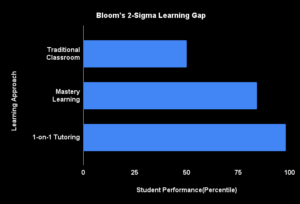
Despite billions in investment, digital learning has historically struggled with “Bloom’s 2-Sigma Problem”. Research shows that students tutored one-on-one perform two standard deviations better than those in a traditional classroom.
Scaling human-led, one-on-one tutoring has been financially impossible for the enterprise and inaccessible to the masses. Digital platforms attempted to solve this with rule-based “personalization,” but these were often just linear tracks. The result? A persistent “skills gap”. Gartner predicts that by 2026, over 80% of enterprises will have used GenAI APIs or deployed GenAI-enabled applications, yet the bottleneck remains the lack of personalized, high-context instruction.
The Core Focus: Reclaiming the Human Element
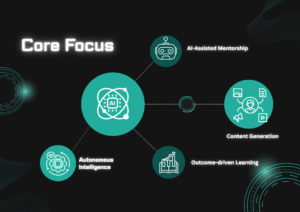
The disruption of EdTech is not merely about “better search”. It is about the rise of Agentic AI – systems capable of autonomous reasoning and workflow orchestration. For the C-suite, the focus has shifted from “delivering content” to empowering human guidance.
-
Teacher Augmentation: From “Content Creator” to “High-Impact Mentor”
The most significant margin expansion in EdTech comes from automating the “instructional middle”. Historically, educators spent nearly 40% of their time on administrative tasks and basic content production.
Arina AI fundamentally shifts this ratio. By generating hyper-advanced, context-aware content – including automated video lectures, in-depth slide decks, and intelligent assessments – Arina AI handles the heavy lifting of information transfer.
- The Result: Instructors are liberated from being “content delivery pipes” and repositioned as mentors and guides. This transition allows human experts to focus on what AI cannot replicate: high-level critical thinking, emotional intelligence, and personalized career coaching.
-
Democratization via “Outcome-as-a-Service” (OaaS)
True democratization of education requires lowering the barrier to mastery, not just the barrier to access. Arina AI facilitates this by shifting monetization toward outcome-linked results.
By utilizing an Interview Preparation Coach and a Case Study Evaluator, Arina AI provides students with instant, objective feedback on complex human skills. This ensures that high-quality, personalized coaching is no longer a privilege of elite education, but a baseline standard available to every learner. This is “ambient expertise” – elevating the quality of instruction 24/7.
Emerging Opportunities: The AI-Driven EdTech Roadmap
As EdTech shifts from a standalone tool to an embedded infrastructure, several high-value opportunities emerge for the forward-thinking enterprise:
| Opportunity Area | Description | Arina AI Alignment |
| Advanced Content Synthesis | Real-time generation of complex materials from proprietary data. | Video & Doc Intelligence: Generating lectures from internal manuals. |
| Operational Efficiency | Automating the administrative overhead of learning and assessment. | Intelligent Form Filler: Streamlining the documentation and grading process. |
| Personalized Mastery | Providing granular feedback on soft skills and technical competence. | Skill Coaching: Real-time analysis of interviews and case studies. |
Strategy for the C-Suite: Two Imperatives
To navigate this disruption and lead the charge in democratizing skills, leaders must focus on enterprise-wide scaling.
- Establish a Compliance-First Data Moat: Arina AI’s private cloud deployment ensures data never leaves your secure environment. This is critical as Gartner notes that data privacy remains a top concern for 70% of organizations deploying GenAI.
- Redefine KPIs for L&D: Move away from “Completion Rates” toward “Time to Proficiency”. If an AI-powered agent can get a new hire to 80% productivity in two weeks instead of six, the ROI is found in accelerated revenue and reduced onboarding friction.
The Bottom Line
The AI disruption of EdTech is a transition from digital libraries to digital colleagues. Arina AI is demonstrating that the true value is no longer in the information provided, but in the autonomy and precision with which that information is applied to solve business problems.
By automating the production of advanced content, we aren’t just making learning faster – we are making it more human by allowing our best minds to return to the art of mentorship. The question for boards is no longer “How much can we save on training?” but “How fast can our organization learn”?
The Executive Edge in Enterprise AI
Get the strategic intelligence that matters. Our monthly newsletter delivers actionable insights on AI ownership, data privacy, and competitive advantages curated specifically for C-level decision makers who refuse to compromise on control.
Sign up for NewsletterStart Your Journey with ArinaAI
Embark on a transformation journey into the future of innovation as you kickstart your exploration of ArinaAI, where limitless possibilities await at every click and command.