From LMS to Learning Intelligence: Architecting the Campus Data Stack
For decades, higher education leaders have asked: “Is our Learning Management System working”? In 2026, that is the wrong question. The right question is: “Is our data an inert liability, or a high-velocity asset powering institutional survival”?
Higher education is currently caught in a “Digital Deadlock”. While the Learning Management System (LMS) remains the digital hearth of the campus, it has fundamentally become a bottleneck – a siloed archive of historical interactions rather than a dynamic engine of intelligence. As we navigate 2026, the strategic pivot isn’t toward a new LMS, but toward a Learning Intelligence (LI) ecosystem.
According to Gartner, this shift requires a transition from monolithic applications to a Composable Architecture, where the value is derived not from the software itself, but from the fluid movement of data across a modular stack. For C-suite leaders-CIOs, Provosts, and CFOs – this is the blueprint for breaking the “LMS-centric” gravitational pull and architecting for the age of Agentic AI.
The Strategic Mandate: Bridging the “Execution Gap”
The industry is currently bifurcating. McKinsey & Company reports that “digital leaders” – those who have rewired their operating models for data fluidity – are realizing 3.3x the total shareholder return compared to laggards in service-based sectors. In academia, this “laggard penalty” manifests as plummeting retention rates and an inability to adapt to the “non-traditional” student majority.
The core problem is the Execution Gap. Gartner’s 2026 research reveals that while 94% of CIOs have high AI ambitions, only 48% of digital initiatives are meeting their ROI targets. This failure is rarely due to the technology; it is due to an architecture that treats data as a “byproduct” of administration rather than the “product” itself.
The Technical Debt: Moving Beyond “Brittle Integration”
Most campuses are currently operating on “Technical Debt” accrued over two decades. Their architecture is characterized by “Brittle Integration” – point-to-point connections where the LMS, SIS, and CRM are tethered by fragile nightly batch processes.
Gartner warns that by 2026, institutions that fail to adopt a Universal Integration Layer will see 40% of their IT budgets consumed by maintenance debt, effectively zeroing out their capacity for innovation. The goal is to move from “System-of-Record” (passive) to “System-of-Intelligence” (active).
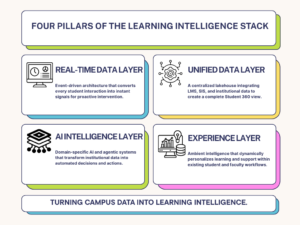
The Four Pillars of the Learning Intelligence Stack
To architect for Learning Intelligence, leaders must move beyond the “app-first” mindset and adopt a “data-first” infrastructure.
1. The Real-Time Layer: Event-Driven Architecture (EDA)
In a competitive landscape, 24-hour data latency is a catastrophic failure. If a student exhibits a pattern of “disengagement signals” – missing three consecutive formative assessments or failing to access digital resources – the intervention must be near-instantaneous.
McKinsey highlights that 88% of high-growth organizations have moved to Event-Driven Architecture (EDA). In an EDA-powered campus, every student interaction is an “event” that can trigger an immediate downstream action – be it an AI-generated nudge or an automated flag for an academic advisor. This moves the institution from reactive triage to proactive prevention.
2. The Storage Layer: The Unified Data Lakehouse
The “Single Source of Truth” has long been a myth in higher education. The LMS knows about grades; the SIS knows about bursar holds; campus facilities know about attendance. Learning Intelligence requires these to converge in a Data Lakehouse.
By treating data as a “product” (a core McKinsey tenet), institutions can create a “Student 360” view that incorporates behavioral, financial, and academic signals. Gartner emphasizes that “context is the differentiator” – without the intersection of financial aid status and LMS engagement, AI-driven retention models will remain dangerously inaccurate.
3. The Intelligence Layer: Domain-Specific AI (DSLMs) vs. Generic LLMs
The current trend of “bolting on” generic LLMs to existing systems is a low-value strategy. The C-suite must prioritize Domain-Specific Language Models (DSLMs). These are models fine-tuned on the institution’s own data, pedagogical frameworks, and privacy policies.
Gartner identifies Agentic AI – autonomous systems capable of goal-setting and reasoning – as the most disruptive force for 2026. These agents don’t just “answer questions”; they act as a virtual registrar, tutor, and advisor, handling up to 70% of routine inquiries with zero human intervention, but with 100% institutional alignment.
4. The Experience Layer: Ambient Intelligence
The final layer is the end of the “Dashboard Era”. Students and faculty don’t need more charts; they need Ambient Intelligence. This is intelligence that lives within their existing workflows.
McKinsey research indicates that hyper-personalized engagement can improve student success outcomes by up to 30%. When the data stack knows a student’s specific “learning friction points”, it can dynamically modify the LMS experience – not just showing content, but re-architecting the content delivery in real-time to match the student’s cognitive profile.
Statistical Reality: Tenacity vs “Cloud Hype”
Gartner’s 2026 CIO Agenda defines Tenacity as the relentless focus on financial outcomes over technological “glitter”. The ROI of a Learning Intelligence stack is measured in “Net Tuition Revenue” and “Operational De-layering”.
| Strategic Metric | Legacy LMS Model | Learning Intelligence Model |
| Data Latency | 24–48 Hours (Batch) | < 10 Seconds (Event-Streamed) |
| Operational ROI | Static/Maintenance-heavy | 25% Increase in Staff Capacity |
| Student Retention | Reactive (Post-failure) | 5–12% Predicted Gain |
| Governance Cost | High (Siloed Audits) | Low (Automated Provenance) |
Navigating the Challenges: Outcome-Driven Governance (ODG)
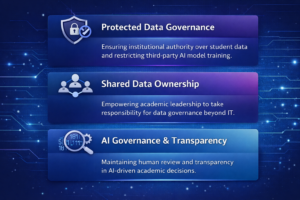
The biggest hurdle is not the data – it is the Governance. Gartner advocates for Outcome-Driven Governance (ODG), which shifts focus from “Who owns the data?” to “Does the data deliver the outcome?”
C-suite leaders must implement:
- Zero-Trust Data Sovereignty: Ensuring student data is never used to train third-party models without institutional control.
- Distributed Accountability: Moving data ownership from IT to the Provost’s office.
- Algorithmic Auditing: Establishing a “Human-in-the-Loop” requirement for any AI-driven intervention that affects a student’s academic standing.
Conclusion: The Architecture of Survival
The shift from LMS to Learning Intelligence is the end of the “Going Digital” phase. We are now in the “Being Digital” phase. Architecting the campus data stack is no longer an IT project; it is the fundamental strategy for institutional survival in an era of demographic shifts and economic scrutiny.
As Gartner notes, the 2026-2027 academic year will belong to the “Radically Outcome-Focused” leader. The question is no longer whether your LMS is working. The question is: Are you architecting for the student of 2006, or the intelligence of 2026?
The Executive Edge in Enterprise AI
Get the strategic intelligence that matters. Our monthly newsletter delivers actionable insights on AI ownership, data privacy, and competitive advantages curated specifically for C-level decision makers who refuse to compromise on control.
Sign up for NewsletterStart Your Journey with ArinaAI
Embark on a transformation journey into the future of innovation as you kickstart your exploration of ArinaAI, where limitless possibilities await at every click and command.