Beyond Raw Data: The Enterprise Intelligence Edge

In today’s hyper-competitive landscape, data is often cited as the new oil. Yet, for many enterprises, their data reservoirs feel more like scattered, untappable lakes than a unified source of energy. The true premium has shifted from mere volume to Enterprise Intelligence: the ability to synthesize every relevant data point – internal, external, structured, and unstructured – into a coherent, actionable, and auditable view of the business.
This transition is often stalled by a fundamental problem: data fragmentation and architectural complexity.
The Fragmentation Trap: Why Traditional Systems Fail
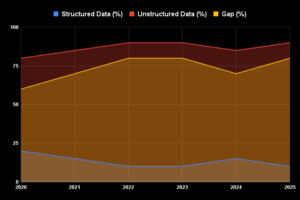
Crucially, modern enterprise data is rarely housed in a single, clean repository. Instead, it is highly fragmented and exists across a vast, complex spectrum of formats and sources. McKinsey research confirms that unstructured data accounts for up to 90% of all data generated globally, and the ability of Generative AI to unlock this information is where exponential value lies. As you can read in the McKinsey article, Charting a path to the data- and AI-driven enterprise of 2030, the challenge is structural.
Enterprise data ecosystems are typically split into three dimensions:
- Internal Data Silos: This includes structured data spread across various departmental databases, as well as large volumes of unstructured data held in spreadsheets, legal filings, financial reports, and other documents.
- Data Complexity and Diversity: This internal data can often be multilingual, cross-domains and in varied formats (images, scanned PDFs, free-text notes), requiring sophisticated tools to process and unify.
- External Data Requirements: Real intelligence requires integrating internal assets with external data sources – such as government policies, legal clauses, financial reports, research papers, and market trends. This dynamic integration is what unlocks the power to anticipate market shifts and be the first to innovate.
 Latency and Complexity: The True Cost of Bottlenecks
Moving data from its fragmented source to an insightful decision is a journey plagued by bottlenecks that impose significant costs in time, resources, and missed opportunities.
As PwC notes, data fragmentation and poor quality are primary barriers to successful AI adoption and real-time operations, as discussed in their piece on Govern your data: Data governance. The challenges include:
- The Interpretation Barrier: Interpreting different kinds/formats of data, sometimes present in lengthy documents, and converting them into a uniform structure. Traditional ETL (Extract, Transform, Load) processes are too brittle and slow for this diversity.
- The Speed-to-Insight Gap: Data integrations are often unavailable in real-time, preventing the instant decision-making necessary to capture dynamic opportunities.
- The Accessibility Tax: Querying data requires technical complexity, forcing decision-makers to rely heavily on data analytics teams. This reliance creates friction and delays, hindering the transition to Automated Decision Engines that Bain & Company highlights as critical for speed and consistency.
- Operational Drag: The heavy processes required to implement data lakes and continuously maintain complex ingestion pipelines divert significant IT resources away from innovation.
- The Trust Deficit: Lack of transparent trail logs makes it impossible to back-track exactly how the data was accessed or derived, leading to low confidence in the produced insights.
The Path Forward: Unifying Intelligence with Arina AI
The solution lies not in re-architecting the entire enterprise data landscape, but in deploying intelligent systems capable of operating across the chaos. The next generation of enterprise AI must be a Data Unification Layer that transforms raw input into real-time, trustworthy, and unified intelligence.
Arina AI offers a foundational shift in how enterprises access and utilize their information assets:
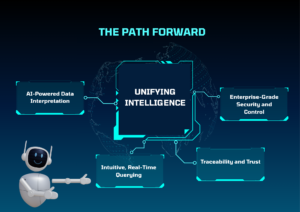
- AI-Powered Data Interpretation and Unification: Arina AI uses advanced language models to interpret various formats of data – from scanned invoices to complex legal texts – and dynamically convert them into a uniform, common structure. This capability eliminates the need for manual data wrangling and heavy pre-processing.
- Intuitive, Real-Time Querying: The platform provides advanced capabilities to query various formats of data using Natural Language Processing (NLP). This shift empowers decision-makers to pull out and integrate needed information in real-time, completely bypassing the technical complexity of SQL or specialized data languages.
- Traceability and Trust: Crucially for enterprise adoption, Arina AI provides comprehensive trace logs with every result. This allows for immediate double-checking and ensures the reliability and governance needed for high-stakes decisions. (This focus on data quality and auditability is something EY identifies as a core requirement for a modern AI-ready data foundation in their article: Data 4.0 – Make Your Enterprise Data AI-Ready).
- Enterprise-Grade Security and Control: The Arina AI platform is built entirely on open-source technology and is designed to be deployed privately, giving organizations maximum control over their data, privacy, and infrastructure. It is built for scale, robustness, and validated against real-world, large data sets with greater precision and accuracy.
By moving beyond rigid data warehouses and fragmented repositories, businesses can finally unlock the 80% of data – the unstructured, messy reality – and convert it into the competitive Enterprise Intelligence needed to thrive.
The Executive Edge in Enterprise AI
Get the strategic intelligence that matters. Our monthly newsletter delivers actionable insights on AI ownership, data privacy, and competitive advantages curated specifically for C-level decision makers who refuse to compromise on control.
Sign up for NewsletterStart Your Journey with ArinaAI
Embark on a transformation journey into the future of innovation as you kickstart your exploration of ArinaAI, where limitless possibilities await at every click and command.