The 2025 AI Pivot: From Flashy Demos to the Goldmine of “Boring” & “Ambient” AI

As we look back at 2025, the conversation around AI has undergone a radical transformation. We’ve moved past the wide-eyed wonder of “What can it do?” to the cold, hard reality of “What is it saving us”?
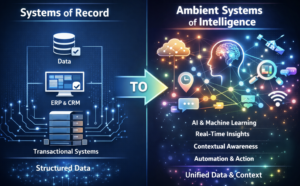
While some critics point to a “Trough of Disillusionment”, a closer look reveals that 2025 was the year of the Strategic Great Divide. The winners weren’t those chasing general – purpose “magic”; they were the teams that mastered the transition from “Systems of Record” to “Ambient Systems of Intelligence”.
Why Most Pilots Failed in 2025
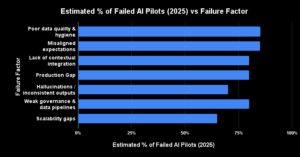
For every HDFC Bank or Apollo Hospital seeing massive ROI, dozens of enterprises remained stuck in “pilot purgatory”. The difference usually came down to two fatal flaws:
- The Data Quality Paradox: While the “winners” saw 400% ROI, 85% of organizations remained paralyzed by poor data hygiene. 2025 proved that you cannot “AI-away” a broken database. The ROI breakthrough was far from universal; it was a reward for those who had spent the previous 24 months doing the “unsexy” work of data consolidation.
- The Non-Deterministic Trap: Many failed projects in 2025 shared a common trait: they expected LLMs to behave like traditional, deterministic software. Teams that tried to use LLMs for rigid, logic-heavy workflows without robust “guardrail architectures” or verification layers saw their projects collapse under the weight of hallucinations and inconsistent outputs.
Scaling Banking & Healthcare via Ambient Intelligence
2025 was a landmark year for AI in India, specifically because organizations stopped forcing humans to interact with software and started making software interact with humans.
- HDFC Bank & Voice AI: By moving from rigid IVR menus to fluid, agentic voice AI, HDFC Bank dropped call resolution times from 8.5 minutes to 2.3 minutes. They succeeded because they built a “deterministic wrapper” around the LLM to ensure banking compliance was never compromised by the model’s creative nature.
- Apollo Hospitals & Ambient EMR: India’s largest hospital chain shifted toward “Ambient Clinical Intelligence”. Instead of a doctor spending hours typing into an EMR (System of Record), the AI listens to the consultation and populates the records in the background. This frees up 2 to 3 hours per day, turning the EMR from a data-entry chore into an invisible assistant.
Global ROI: From Developer Gains to Healthcare Breakthroughs
- Developer “Force Multipliers”: Engineering teams using Claude and GitHub Copilot reported productivity gains of 35% to 50%. However, the real ROI wasn’t just “faster code”; it was the autonomous refactoring of legacy technical debt that had been stagnant for decades.
- Healthcare Savings: Systems like Mount Sinai and University of Utah Health saved roughly $100M annually by using predictive AI to close “care gaps”. They avoided the non-deterministic trap by using AI to flag risks for human review, rather than making autonomous medical decisions.
Context & Continuity: The Arina AI Blueprint
The breakthroughs of 2025 didn’t just “happen”- they were engineered. At Arina AI, we’ve spent the last year calling the shots on the architectural shifts that are now separating the market leaders from the laggards. To understand the “how” behind the ROI, revisit our core blueprints:
- Building Foundational AI Excellence: Why the era of the “prompt” is dead. We break down the Arina advantage: shifting from passive chat to Agentic Orchestration – where systems don’t just talk, they resolve.
- The Strategic Imperative of Enterprise Intelligence: Forget digital transformation. This is about the evolution into Intelligent Ecosystems. We explore why proprietary intelligence layers are no longer an “option” but the only defensive moat left for the modern enterprise.
Key Learnings: How to Win in 2026
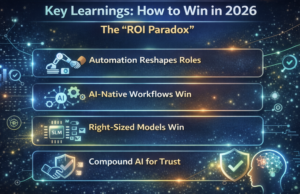
The “ROI Paradox” taught us four vital lessons for the coming year:
- The “Augmentation vs. Reduction” Reality: While 2025 focused on “augmenting” staff to reduce burnout, we must be honest about the socio-economic shift. As “Autopilots” take over background tasks, the headcount need for administrative roles will shrink. The ROI of 2026 will come from leaner, highly leveraged “super-employees”.
- Workflow Redesign > Technology Patching: Success came to those who fundamentally reimagined the workflow around the AI’s capabilities, rather than just plugging an LLM into a broken process.
- The Efficiency of “Small” (SLMs): Enterprises found that Small Language Models (SLMs)-deployed privately-slashed inference costs by up to 80%. “Right-sizing” the model to the task became the hallmark of the sophisticated 2025 architect.
- Solving for Non-Determinism: The most successful 2025 deployments used “Compound AI Systems”- combining LLMs with traditional code and knowledge graphs to ensure that while the interface is natural, the output is verifiable and consistent.
Evolving Thoughts for 2026: The “Ambient” Renaissance
As we enter 2026, the strategy is shifting from “Flashy AI” to “Ambient AI”. We are moving away from traditional digital systems (EMRs, LMSs, CRMs) that require manual data entry, toward intelligent systems that operate in the background.
- From “System of Record” to “System of Intelligence”: The “boring” tasks of 2026-invoice reconciliation, vendor vetting, and data entry-will happen via background agents. The UI is disappearing; the system simply “knows” and “does”.
- The Restoration of Deep Work: In 2026, “efficiency” will be rebranded as “freedom”. The ultimate ROI won’t just be measured in dollars, but in the restoration of time for high-value employees who have been drowning in digital administrative tasks for two decades.
The Lesson of 2025
The “ROI Reality Check” of 2025 proved that generic implementation was overhyped. The companies that won were those that stopped “chatting” with AI and started building invisible, ambient architectures to solve specific, high-friction problems.
Are you still feeding your software data, or is your software already working for you?
The Executive Edge in Enterprise AI
Get the strategic intelligence that matters. Our monthly newsletter delivers actionable insights on AI ownership, data privacy, and competitive advantages curated specifically for C-level decision makers who refuse to compromise on control.
Sign up for NewsletterStart Your Journey with ArinaAI
Embark on a transformation journey into the future of innovation as you kickstart your exploration of ArinaAI, where limitless possibilities await at every click and command.