The AI-Powered Campus: Meeting the Netflix Expectation
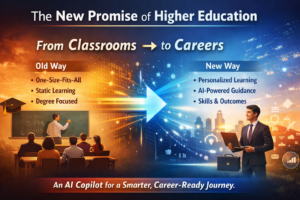
For decades, the value of a college degree was a simple fact. It was a “golden ticket” based on the school’s name and a paper diploma. But as we move toward 2030, that has changed. We are moving away from an era of just earning “credits” and into a time where students must prove they have the “skills” to do the job.
Today’s students grew up with technology. They are careful with their money and worried about a fast-changing job market. They no longer see a degree as just a rite of passage. Instead, they see it as a major financial investment. They aren’t just looking for a famous school name; they want a clear and measurable Return on Investment (ROI). They expect an education that is as personalized as their Netflix feed, as relevant as the daily news, and as closely tied to their future jobs as a professional apprenticeship.
The Expectation Gap: A Crisis of Confidence
The data shows that traditional university models are struggling to keep up with these new demands. Public trust is at an all-time low. Gallup recently reported that only 36% of U.S. adults say they have high confidence in higher education (Gallup, 2024). For university leaders, this is a serious threat to their institution’s future.
In 2026, the reason students enroll is clear. According to the Lumina-Gallup State of Higher Education 2024 Report, 84% of students say getting a good job is their main reason for going to college. At the same time, 57% of students at four-year schools feel that tuition costs do not match the value they receive.
This “Value Gap” exists because students want a level of support and career prep that old systems weren’t built to handle. Delivering personalized, 24/7 guidance to thousands of students is impossible through human effort alone; it requires an intelligent, scalable technological foundation. To close this gap, leadership needs a new strategy – The University AI Copilot.
The Strategic Solution: The AI Copilot
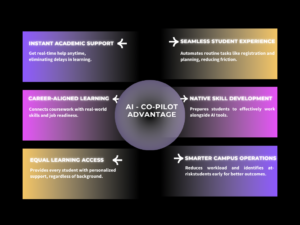
The University AI Copilot is the best way to give students the help and career readiness they demand. It turns the student experience from a “one-size-fits-all” model into a 24/7 support system that respects the student’s time as much as their tuition.
1. Meeting the Demand for Personal Support
For university leaders, keeping students in school (retention) is the most important goal. The numbers are concerning: 41.9 million American adults have started college but never finished (State of Higher Education, 2024). Most leave because of stress or a lack of quick, personal help.
AI Copilots act as a digital safety net. They provide learning support exactly when students need it. Recent studies (David Publishing, 2025) show that students using AI tools perform much better than those in traditional classrooms alone.
- Instant Help: Instead of waiting 48 hours for an email or trying to find a professor’s office hours, a student stuck on a hard problem at midnight gets instant help based on their specific course.
- Removing Roadblocks: By handling the “boring” stuff – like registration, financial aid questions, and degree planning – the AI Copilot removes the frustration that often makes students want to quit.
2. Preparing Students for an AI World
Modern students are worried about their future. They know they will have to work alongside AI. A survey by the Digital Education Council (2024) found that while 86% of students use AI to study, nearly half feel their university is not teaching them how to use AI for their future jobs.
By launching an official university AI tool, leaders move from “banning” AI to “partnering” with it:
- Real-World Practice: Students want tools that go beyond books. They want AI that helps them practice for interviews, simulate business meetings, and show them how their classes match the skills employers are hiring for right now.
- Keeping Data Safe: Unlike public tools like ChatGPT, a University Copilot is a “walled garden”. It protects the school’s research and keeps student data private – a top priority for the 72% of students who worry about AI privacy (Jisc, 2025).
3. Making Education Fair for Everyone
Fairness is a major challenge in higher education. Usually, students from wealthy families have access to private tutors and better networks. Today’s students expect the university to make things equal for everyone. The AI Copilot does this by giving every student, regardless of their background, their own 1-on-1 mentor.
Data from Engageli (2026) shows that schools using AI for personal learning saw 12% higher attendance and 15% fewer dropouts. This is vital for the 60% of students who work while going to school (Gallup, 2024). For a student working a night shift, an AI study session at 2:00 AM is the only way they can finish their degree.
4. Saving Money and Improving Results
From a financial view, the AI Copilot helps the university do more with fewer people.
- Handling Common Questions: AI systems can answer up to 40% of routine questions about campus life and admissions. This lets human staff focus on students who have complex, personal crises that need a human touch.
- Catching Problems Early: These systems see when a student is starting to fall behind weeks before they fail a test. According to Scientific Reports (2025), AI tools can make studying 57% more efficient, helping students graduate faster and happier.
Leadership Strategy: Transforming Your Campus
Moving to an AI-powered campus is a long-term journey, not a quick fix. For the C-Suite, the strategy should focus on three main areas:
- Keep Your Data Under Control: Don’t just give your data to big tech companies. Build a secure “wrapper” for your AI. This lets you use powerful AI technology while keeping your school’s lessons, research, and student data safe and private.
- Help Teachers, Don’t Replace Them: AI should never replace professors. It should handle the simple “how-to” questions so that faculty can spend more time on what they do best: mentoring students and conducting research.
- Change How You Measure Success: Update your goals. Don’t just look at grades. Use AI data to track “skill mastery” and how quickly graduates find jobs. This ensures your classes are actually helping students get hired.
The New Promise of Higher Education
The move “From Classrooms to Careers” is no longer just a hand-off at graduation; it is a continuous, tailored journey. Just as Netflix anticipates exactly what a viewer wants to watch next, the modern university must use data to anticipate the skills a student needs to learn next. In 2026, students aren’t just buying a degree; they are buying into a smart system that guarantees they will be ready for the real world.
A University AI Copilot is the sign of a forward-thinking school. It delivers the hyper-personalized, on-demand experience that the “Netflix generation” expects, while solving the money worries of parents, the career fears of students, and the daily headaches of staff. In today’s world, ignoring this change is a fast track to being left behind.
The question for leaders is no longer if AI belongs on campus. The question is: How fast can you give your students the personalized, streaming-era support they need to lead an AI-driven future?
The Executive Edge in Enterprise AI
Get the strategic intelligence that matters. Our monthly newsletter delivers actionable insights on AI ownership, data privacy, and competitive advantages curated specifically for C-level decision makers who refuse to compromise on control.
Sign up for NewsletterStart Your Journey with ArinaAI
Embark on a transformation journey into the future of innovation as you kickstart your exploration of ArinaAI, where limitless possibilities await at every click and command.